Università degli studi dell'Insubria



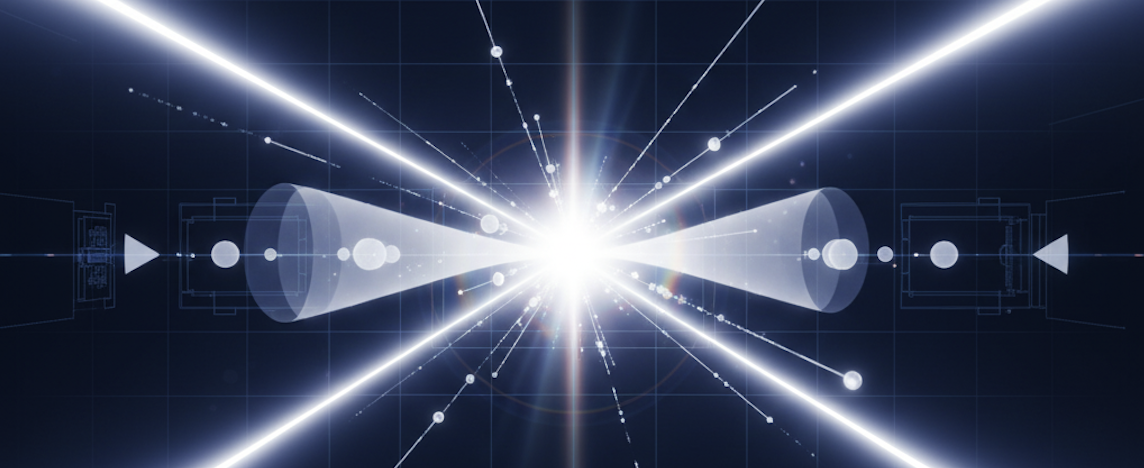
Every prediction we compare with collider data, such as a cross-section at the LHC, comes from a scattering amplitude. Beyond the simplest approximation, amplitudes are built from Feynman integrals: integrals over the momenta of virtual particles running in loops. At two or three loops a single process can require thousands of them, and evaluating them is one of the main bottlenecks of precision physics.
Luckily, these integrals are not independent. Linear relations (integration-by-parts identities) reduce them to a small basis of master integrals, a bit like expressing any vector in terms of a basis. Two natural questions follow: how many master integrals are there, and why that number?
I look at Feynman integrals as periods, that is, pairings between a differential form and an integration cycle. The number of master integrals then becomes the dimension of a (co)homology group, a question about the geometry hidden in the integral rather than about its explicit computation.
Following recent ideas of Kontsevich and Soibelman on exponential integrals, I decompose these integrals into Lefschetz thimbles, the multidimensional analogue of steepest-descent contours. As the kinematic parameters vary, the thimbles can jump: this wall-crossing phenomenon (related to the Stokes phenomenon of asymptotic analysis) governs how integrals are analytically continued, and gives a sharp count of master integrals. I am also developing computational tools (Mathematica, Macaulay2) to turn these ideas into practical methods.